

By Gert Schmidt
Hindle Mason Projects (HMP) repairs damaged concrete reinforcement, a critical step in overall concrete repair. This is considering the role that reinforcing steel plays in ensuring the structural integrity of concrete infrastructure.
The thermal expansion properties for both steel and concrete are very similar. This, while steel provides excellent bendability properties making it ideally suited to reinforcing structures. Furthermore, it bonds well with concrete. In prestressed concrete structures, the reinforcement is stressed prior to subjecting them to loading. Passive steel reinforcing bars are strong in tension and, at the same time, ductile enough to be shaped or bent.
However, over time, reinforcing bar is exposed to deleterious agents that cause it to deteriorate, compromising its load-carrying capacity.
Just after concrete has been placed, a protective layer of passive alkaline material bonds to the surface of reinforcing steel. Water with a high concentration of chloride-ions forms an ideal electrolyte solution promoting electromechanical reactions. It migrates through the concrete matrix via its interconnected network of capillary pore structures. Once this electrolyte solution reaches the steel reinforcement, it breaks the protective layer.
Corrosion is initiated when electrons migrate from electrically active points on the steel to a location on the bar with opposite polarities. This, while ferrous ions lost from the steel diffuse into the surrounding concrete. When the electrolyte solution contacts an active area, iron hydroxide starts to form on the reinforcing bar.
This rust reduces the load-bearing capacity of steel, lowering its effectiveness at carrying structural loads in tandem with the concrete. Notably, as the steel reverts to an iron oxide, its volume increases by two or three times. This places significant internal forces against surrounding concrete causing cracking, providing a point of entry for more deleterious agents. It also compromises the bond between the steel and concrete.
HMP’s concrete reinforcement repair approach
HMP’s concrete reinforcement repair approach starts by determining the steel bar location, depth, size and ratio. This is done with tools like a bar locator and cover meter. Refer to Top Guide of Rebar Detectors Concrete Work – Langry.
We then carefully remove the compromised surrounding material to expose the rebar. To avoid damaging the reinforcing steel, the process needs to be executed with precision. Vibration must be minimised to prevent loosening the bond between the steel and surrounding concrete.
Full removal of concrete is unnecessary if the bars are partially exposed. However, when the rebars are corroded and not properly bonded, concrete must also be removed behind the rebar. The clearance behind the steel is usually a maximum aggregate size plus an additional 6mm.
We then thoroughly clean the reinforcing using sandblasting techniques to assess the degration. This is important to determine if they need to be repaired or replaced. A wire brush is used for areas that are difficult to access.
Exposed reinforcement that is sound is cleaned of rust and loose mill scale and the area reinstated.
Where there are signs of corrosion deterioration, rebar is cleaned of corrosion by wet grit blasting.
Immediately thereafter, we prime the reinforcing with a suitable system. An approved zinc-rich product delays the attack of aggressive elements.
We apply it with a brush to ensure that all exposed reinforcement steel is coated. This, while paying attention to the correct application of the primer to the back of the reinforcement bar. This is in addition to the areas that are tied together. It is essential that the coating is continuous with that of any adjacent primed repaired area. We also avoid excessive overpainting onto the concrete and then allow it to dry.
HMP’s concrete reinforcement repair techniques
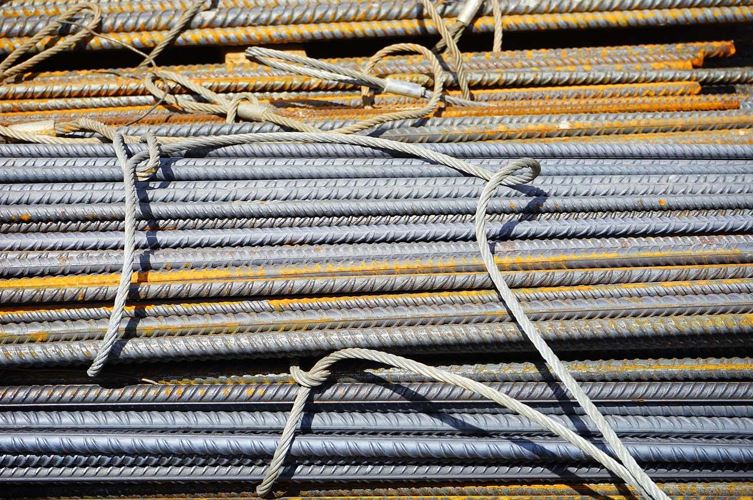
HMP’s concrete reinforcement repair techniques for steel reinforcement bars [Reinforcing bar] and prestressed strands are highly specialised.
If sections of steel rebar are severely damaged, we will replace them. The replacement bars are spliced into place using lap splices [Lap Splices – CRSI: Concrete Reinforcing Steel Institute]. This is undertaken according to SANS10144 | PDF.
Alternatively, welded splices can be used, although they are not suited to reinforcing bars larger than 25mm. This is because they can crack surrounding concrete. We also use mechanical connections to splice reinforcing steel. Refer to Splicing Bars – CRSI: Concrete Reinforcing Steel Institute.
When existing rebars have lost cross-sectional areas or need strengthening, supplemental bars are added adjacent to them. Their length is equivalent to the deteriorated portion plus the lap splice length on either side. To safeguard against corrosion, we treat them with protective coatings with an epoxy or polymer cement slurry. Refer to Epoxy-coated reinforcement. The coating thickness never exceeds 0,3mm to avoid compromising bond development at the deformations.
Other HMP concrete reinforcement repairs
Other HMP concrete reinforcement repair methods are used for prestressing steel, including bonded strands and unbonded tendons.
Bonded strands are at risk of when there are potential weaknesses in the protection system. Permeable or cracked concrete also potentially raises the risk of corrosion. Weaknesses can also occur when the post-tensioning ducts are not adequately spliced or lack adequate impermeable concrete cover. Voids, bleed water or cracks in cement grout can also be problematic. The prestressing steel may also be susceptible to corrosion if inadequately handled during transport and construction. Refer to JL-08-January-February_Corrosion_Risk_of_Bonded_Post-Tensioned_Concrete_Elements.pdf.
Only damaged exposed sections of bonded strands are replaced. A new section of strand is connected to the undamaged ends of the existing strand. Both the new and exposed lengths of the existing strands must be post-tensioned to correlate with stress level of the bonded strand. This ensures the structural integrity of the member is restored.
Unbonded tendons are protected from corrosion by sheathing or corrosion-inhibiting materials. However, if corrosion has occurred, the damaged portion is exposed by removing the concrete and sheathing.
The primary cause of corrosion is moisture accumulation within the sheathing. This includes pitting corrosion, which can result in sudden, brittle failure of the strands.
We test its integrity using a lift-off test. Refer to Best Practices for Post-Tensioning Elongation Records.
In instances where there is excessive corrosion, the strand must be replaced or spliced. Shoring of the affected and adjacent spans is sometimes necessary before removing or re-tensioning them.
Learn more about HMP. www.hindlemason.co.za
Schmidt is an HMP Director