
By Ben du Preez
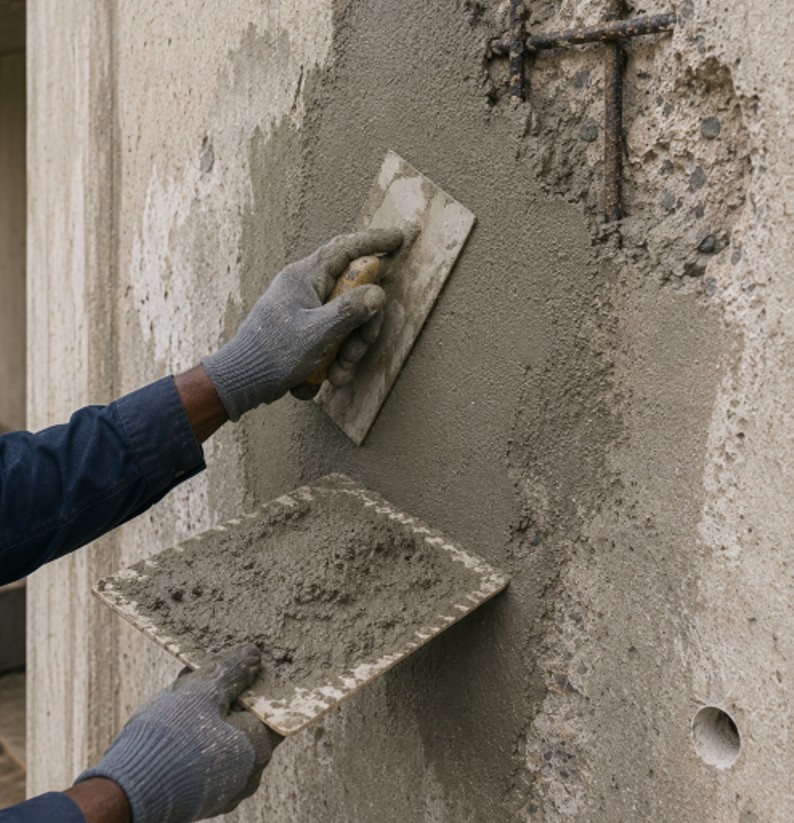
Hindle Mason Projects (HMP) ensures that concrete patch repairs are done right.
Neatly finished patches, flush with the surrounding concrete and apparently sound, does not mean that the problem has been solved. Beneath the surface, the repair itself may have created the conditions for the next failure. This is through the incipient anode effect, more commonly known as the halo effect.
This is a phenomenon we encounter regularly, particularly on structures exposed to chlorides or carbonation. In many cases, repairs are executed to a high standard, only to fail within 12 to 24 months. This is because the underlying corrosion mechanism was not fully understood or addressed.
Premature concrete patch repair failure
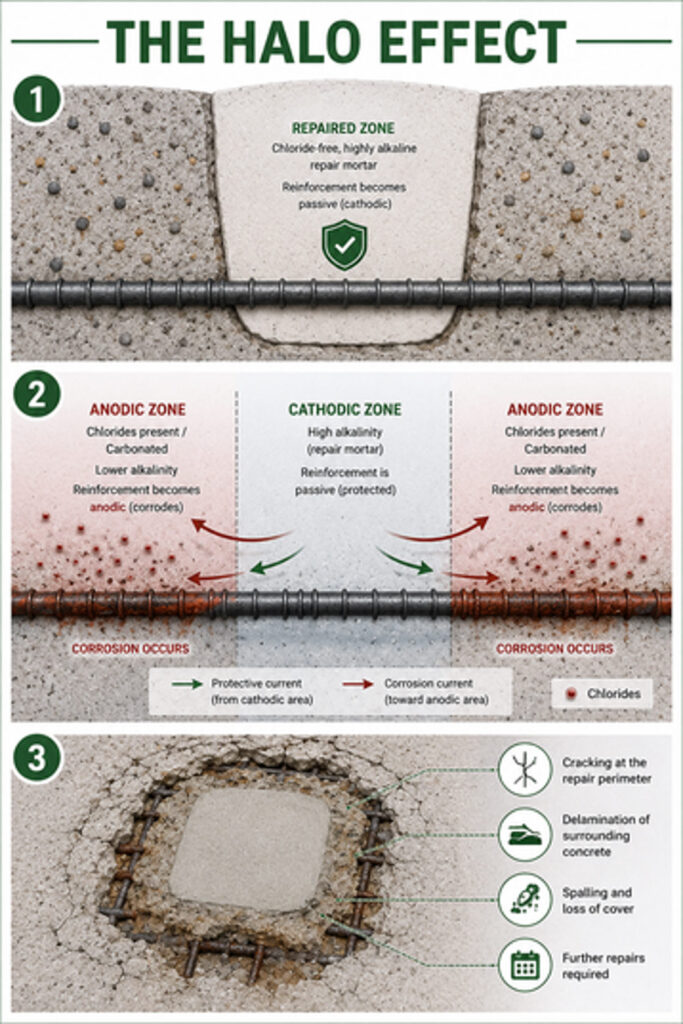
The halo effect is one of the most common causes of premature concrete patch repair failure. It occurs when a deteriorated area is removed and replaced with a chloride-free, highly alkaline repair mortar. The reinforcement within the repaired zone becomes passive and protected, effectively forming a cathodic area. However, the adjacent concrete often still contains chlorides or has lost alkalinity through carbonation. This creates a contrasting electrochemical environment. As a result, the surrounding reinforcement becomes relatively anodic and corrosion simply migrates to the perimeter of the repair.
The outcome is a characteristic ring of deterioration around what initially appears to be a successful repair. While the new patch remains sound, the surrounding concrete begins to crack, delaminate and eventually spall, requiring further intervention.
Failed concrete patch repair strategies
More often, it is the consequence of failed concrete patch repair strategies. This is because they only addressed the symptoms of corrosion rather than the corrosion mechanism itself.
The process begins when chloride ingress or carbonation breaks down the protective environment around the reinforcing steel. Refer to Chlorides and concrete. | Concrete Society and Carbonation of concrete | Concrete Society. This initiates corrosion and causes localised cracking and spalling. The visibly deteriorated concrete is then removed and replaced with a high-performance repair mortar. This restores a highly alkaline environment and re-passivates the reinforcement within the repaired area.
However, the surrounding concrete often remains contaminated by chlorides or affected by carbonation. This creates a difference in electrochemical potential between the repaired zone and the adjacent concrete, establishing a macrocell corrosion cell. The reinforcement within the repair becomes cathodic. Meanwhile, the surrounding steel becomes anodic, causing corrosion to migrate to the perimeter of the patch.
The result is a characteristic ring of cracking and spalling around an otherwise sound repair—the hallmark of the halo effect. Unless the electrochemical imbalance is addressed, the cycle simply repeats itself, progressively extending the area of deterioration.
Effective concrete patch repair remediation
Effective concrete patch repair remediation begins with a comprehensive condition assessment. Visual inspections should be supported by chloride profiling, carbonation depth measurements and half-cell potential mapping. This identifies the full extent of corrosion activity, not just the areas where cracking and spalling have occurred.
The repair strategy should also extend beyond the visibly deteriorated concrete. Removing only the damaged patch often leaves chloride-contaminated or carbonated concrete immediately adjacent to the repair. This allows corrosion to continue. Where extending the repair is impractical because of cost, access or structural constraints, the residual corrosion risk should be managed. This is done using appropriate protection systems.
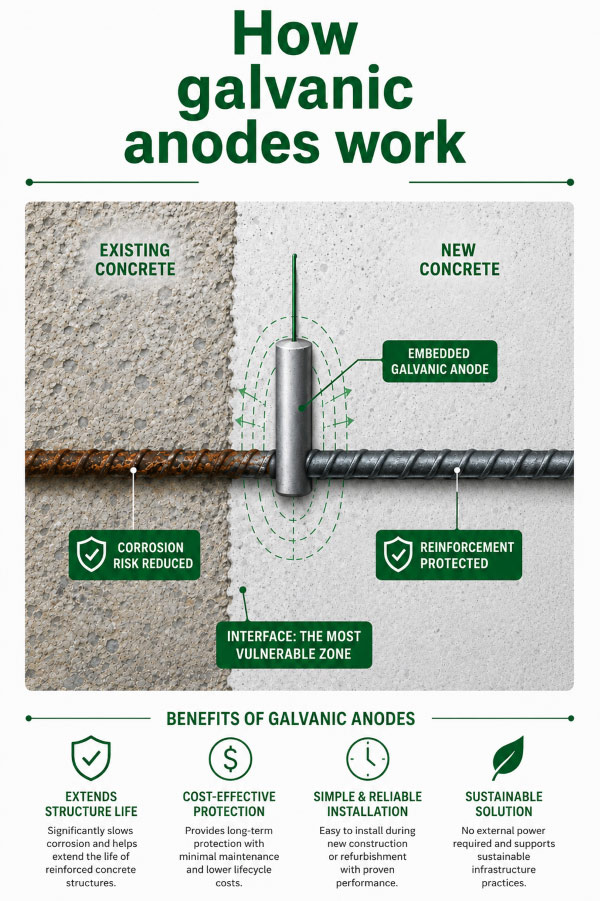
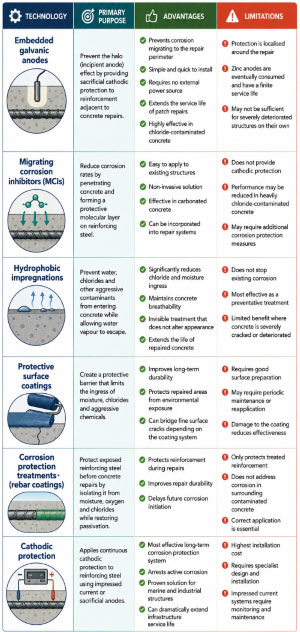
Corrosion management measures such as embedded galvanic anodes are particularly effective. They act as sacrificial anodes to protect reinforcement at the interface between new and existing concrete.
Typically manufactured from zinc, these are installed around the perimeter of a concrete repair. There, they corrode preferentially to the reinforcing steel. By supplying a protective current to the surrounding reinforcement, they prevent the adjacent steel from becoming anodic. This interrupts the electrochemical process that drives the halo effect. They are simple to install and require no external power source.
Successful concrete patch repairs
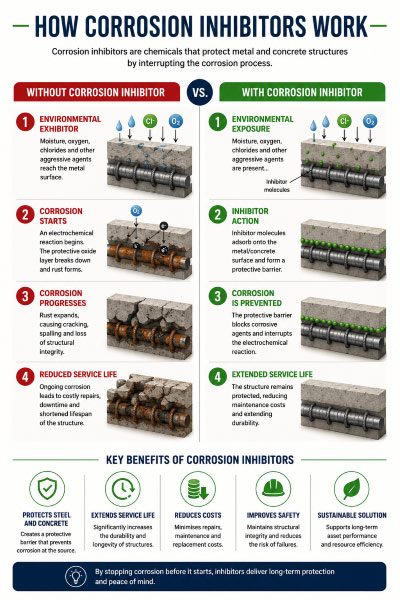
Migrating corrosion inhibitors also ensure successful concrete patch repairs by reducing corrosion rates in carbonated concrete.
They are applied to the concrete surface or incorporated into repair systems. These chemical compounds penetrate the concrete matrix and migrate to the reinforcement. There, they form a protective molecular layer that reduces both anodic and cathodic corrosion reactions. Unlike sacrificial anodes, they do not provide cathodic protection but instead suppress the electrochemical processes that drive corrosion. While particularly effective in carbonated concrete, their performance may be reduced in heavily chloride-contaminated structures. In these instances, additional corrosion protection measures may be required.
After concrete patch repairs
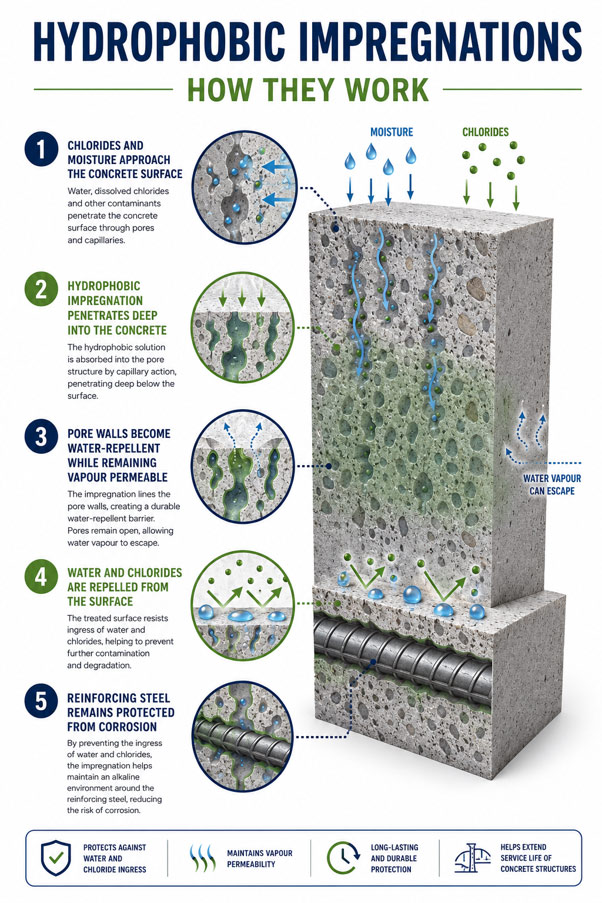
Hydrophobic impregnations and protective coatings are often applied after concrete patch repairs. This is to prevent chlorides, moisture and other aggressive contaminants from penetrating the surrounding concrete. Rather than stopping existing corrosion, they create a protective barrier that limits further ingress of harmful substances. This reduces the risk of corrosion developing in adjacent reinforcement. They lower concrete permeability while allowing the structure to remain vapour permeable, preserving the repaired area. When combined with sound repair design and appropriate corrosion management measures, they provide an effective defence against future deterioration.
Hydrophobic impregnations penetrate deep into the concrete and chemically bond to the walls of its pores. This makes the pores water repellent without sealing them. This prevents rainwater, chlorides and other aggressive contaminants from entering the concrete while still allowing water vapour to escape.
Corrosion protection treatments are coatings applied directly to exposed reinforcing steel before concrete repairs. They form a protective barrier that isolates the steel from moisture, oxygen and chlorides while restoring the highly alkaline environment that promotes steel passivation. This helps delay corrosion and improves the long-term durability of the repair. Refer to Corrosion protection methods of steel in concrete – ScienceDirect.
Concrete patch repairs: severe environments
However, there may be only one reliable long-term solution for concrete patch repairs in severe marine, industrial or other aggressive environments, namely cathodic protection. This is more complex and costly to install. Yet, this method has a proven track record of arresting corrosion and significantly extending the service life of infrastructure.
HMP is a leading provider of concrete repair and corrosion protection solutions. This is a reputation that we have earned over more than three decades. We look forward to helping you to prolong the lifecycle of your critical concrete assets.
Du Preez is a Contracts Manager of HMP: www.hindlemason.co.za